The Whistletrip: Itinerary
- Days 1 & 2: Marrakech
- Day 3: High Atlas Mountains & Roses Valley
- Day 4: Dades Valley & overnight Sahara Desert camp
- Day 5: Drâa Valley to Marrakech
Why Go
Labyrinthine souks piled with sparkling crafts. Soaring snow-capped mountains towering above deep golden gorges. Sand dunes glowing in the Saharan sunset. Central Morocco’s diverse landscape is made all the more exotic by the sounds of spoken French, Berber, and Arabic.
The region is a budget-friendly destination, with luxury riads available at prices far below those charged elsewhere for equivalent comfort and 2* or 3* characterful kasbahs offering welcoming guestrooms with meals for less than $50 per night. Traditional furnishings and historical architecture make staying in unique accommodation a core part of any visit.
To Travel Agent or Not To Travel Agent
For Marrakech – definitely not. For adventures outside the city, I had a wonderful experience with Camel Safaris, booked through Viator and selected after extensive research – some operators receive dreadful reviews. The Camel Safaris’ 3 day-2 night tour was unbelievable value for money at $210 per person for the trip, including a driver-guide with a spotless SUV, most meals, camel back rides to and from the Saharan sand dunes and charming accommodation for two nights.
This price is predicated on a group of four. I was lucky to have been paired with a relaxed honeymooning couple who were also petite – a blessing given rotating stints in the car’s middle seat. Get a private tour if you can or check that the SUV can open up two further seats in the back and put bags on a roof rack. Camel Safaris’ guides speak English, French, Spanish, and Arabic: request knowledgeable, considerate, careful Khalid.
Practical Planning
February offered an ideal combination of sunny days and few crowds. Book travel well in advance for a spring visit – April and May see hordes of tourists.

- Pack: Be sure to take layers of very warm clothes for a night in the desert – even if you visit during the summer, the nights are freezing. Thick woolen socks are particularly helpful. Have a small soft bag for overnight items – large or rigid bags cannot be mounted onto camel back. Motion sickness medication is handy if you get queasy on long car rides.
- Cellphone: Check your cellphone contract before leaving home. My otherwise brilliant global plan did not automatically include Morocco’s pay-as-you-go structure. Cell coverage is patchy and wifi is not reliable beyond Marrakech, so be prepared to go off the grid for large chunks of the day.
- Money: Carry euro – dollars and credit cards are rarely accepted outside cities. Visa or Mastercard are more widely accepted than American Express, even in major cities.
- Mobilize: There is effectively no Uber. In Marrakech, taxi rates are fixed – ask cab drivers to show you the official tariff card if in doubt about the appropriate fare.
Days 1 & 2: Marrakech
After factoring in transit, I really had only 1.5 days in Marrakech, which I focused around the 11th century souk-filled UNESCO World Heritage Site, the Medina.


Bring patience, humor and a detailed map inside its walls. Few signposts, aggressive vendors and decidedly unhelpful directions from locals can make an otherwise fun expedition rather taxing. Niche souks focused on selling carpets or leather wares or spices are densely packed and heave with smells of the products. Treasure-filled stores piled high with glistening lanterns, jewelry, richly colored textiles and intricately patterned woodwork lure those with even the slightest magpie-like tendency. Egregious negotiating is necessary – never name your price first, and whatever price you are offered, ask for half off or more.
In the thick of bargaining for crafts, it is easy to forget the rich cultural significance of the Medina. Mosques are tucked in its alleys, curtains drawn across the doorways in their white and blue tiled walls. South of the souks is Place Jamaâ El Fna (or Jemaa El Fna), a bustling market square that has been the heart of the city since its founding and is filled with snake charmers, street performers, fruit juice vendors, and inevitably pickpockets, so hold onto your belongings.
- Don’t Miss: Riad Yima – an absolute original. After being ushered through the nondescript door by a smiling old lady with little English, I stepped into the most amazing pop-art inspired boutique, teahouse and art gallery, showcasing the works of British-Moroccan portraitist Hassan Hajjaj, dubbed Morocco’s Andy Warhol.
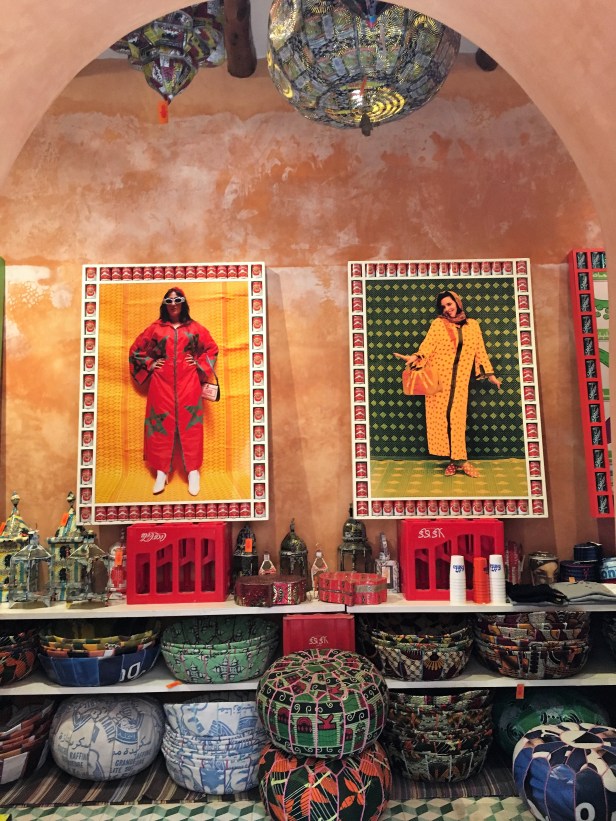
Works by Hassan Hajjaj on display in the funky Riad Yima © The Whistletrip 

- Stay: Riad Idra epitomizes excellent hospitality. In a quiet alley in the Medina, each of the 7 rooms in this boutique guesthouse has been exquisitely designed for airiness while incorporating the exotic intricate woodwork and patterned textiles of the region. Breakfast in the delightful sun room includes delicious sultana-filled and honey-soaked rolled over pancakes.

Inside the Riad Idra © The Whistletrip Le Jardins de la Koutoubia has a convenient location on the edge of the Medina, only a 10 minute drive from the airport. The rooftop pool – one of three – looks over the Koutoubia Mosque’s elegant minaret, and hearing the call to prayer in such close proximity is magical. Ignore the hotel’s 5* rating: even in my free-upgrade suite, the somewhat worn red velvet couches and fading mirroring showed this to be a slightly tired 4 star establishment. La Mamounia, a member of The Leading Hotels of the World, has resort facilities – 136 pretty rooms, an enormous pool area, impeccably manicured tranquil gardens, clay tennis courts, a boulodrome and world-renowned restaurants. La Mamounia is the 5* choice for longer visits as a haven from the mayhem of the souks, but the common areas have a whiff of high-end Vegas: for shorter stays stick with intimate luxury riads inside the Medina.
- Eat: Chic rooftop restaurant Terrasse des Épices specializes in house tagines, served deep in the heart of the Medina. At the bottom of its stairs, before heading up to the main restaurant, is La Patisserie with baklava and artisanal ice creams. Naranj has delicious Lebanese food that is particularly welcome when you can’t face more tagine. Split the mezze platter between two and enjoy the aubergine with couscous and yoghurt.
- Hidden Gem: Le Musée d’Art et de Culture de Marrakech at 61 Rue de Yougoslavie in the well-heeled Guilez neighborhood, an 8 minute cab ride from Jemaa El-Fna. The stimulating permanent collection spans early 20th century photography and 19th century paintings to enormous 17th century decorated doors, all elegantly curated in a calm contemporary space. A reading nook decorated with vintage Morocco-themed movie posters provides free Nespresso coffees to sip on while leafing through handsome books on Matisse’s 1912-1913 stint in the country.
- Skip On: Walking through the Medina in the dark if you are a solo woman. It’s uncomfortable, no two ways about it.
Day 3: Drive through High Atlas Mountain to Roses Valley
An 8am pick up kicked off the drive through the scenic High Atlas Mountains. Oleander, poplars, walnut and white blossoming almond trees lined the snaking roads, with a sprinkling of stalls selling fossils, hand painted ceramics, Argan oil and textiles. As we wound our way up to the Tizi n’Tichka Pass at 7,400 ft, we looked down at Berber villages snuggled in the valleys, fields of bright green wheat carefully arranged around them.

We descended into the Ounila Valley to Ouarzazate and a first glimpse of the ksar, or fortified village, of Aït Benhaddou, a UNESCO World Heritage Site that has appeared in movies including Oedipus Rex and Gladiator. Dating back to the 17th century, Aït Benhaddou was a trading post on the commercial route linking ancient Sudan to Marrakech.
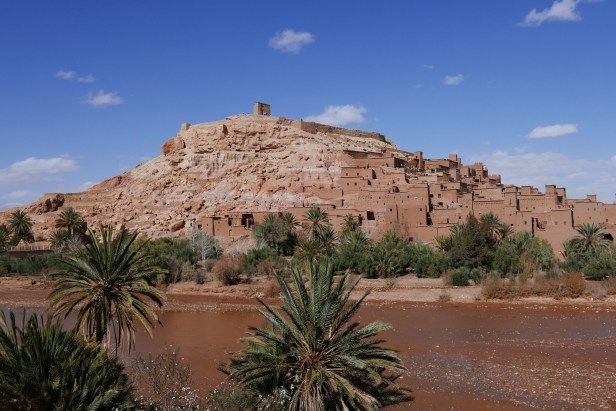
Narrow lanes packed with the remains of houses meander up a sandy colored hillside, providing an occasional glimpse down at a donkey or goat penned in along a wall in signs of animal husbandry: four families are said to live in the ksar today.

Continuing on towards the Skoura Oasis, we drove through Berber villages that meld together, each distinguishable from the next only by the appearance of a mosque, whose minaret loomed pink into the sky – often with a stork’s nest at the top. Butchers’ windows were flung open, proudly displaying prime cuts of halal meat, and we could peer briefly into tea houses hosting gatherings of men. Occasionally we passed a rural market, where a truck filled with animals that had earlier lapped us now parked to trade. Often women hobbled along the road with slings across their backs that were bursting with long grass.

Close to 5.30pm we arrived at Kasbah Itran – welcomed by mint tea, savory cookies and a warm fireplace. Having anticipated for the price a very basic hostel, I was thrilled to find a charming guesthouse made in the traditional style from rock and thatch. Balconies and terraces cascaded down one side for stunning views over the Roses Valley – views that were shared by the comfortable bedrooms, huge with soft beds covered in warm blankets and private tiled shower and toilet.

Dinner was a feast of vegetable tagine and fluffy flat bread, eaten from low tables while cross legged on seating mats, and followed by the staff beating hand drums to sing folk songs before sleep.
- Eat: Roadside and village restaurants mainly serve bland tagines and watery spaghetti. One dish to try from their me-too menus is Omelette Berber – onions and peppers sautéed in spices then covered over with bubbling eggs.
- Stay: Two families on self-drive vacations were also staying at Kasbah Itran. Rooms with four beds are available, so this is a terrific spot for groups.
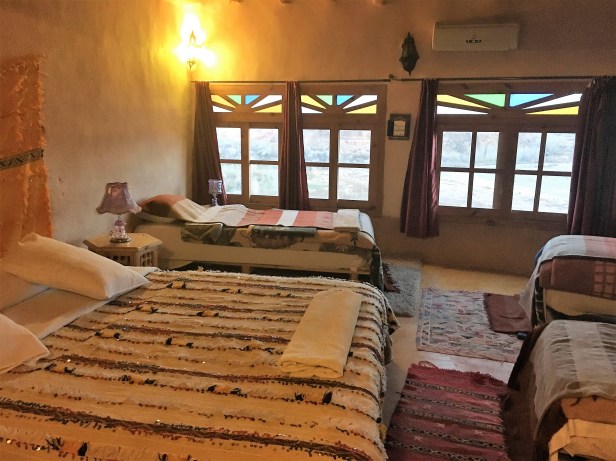
Family room in Kasbah Itran © The Whistletrip
Day 4: Drive through Dades Valley to overnight Sahara Desert camp site
We set off after breakfast through the Dades Valley, lined with fig trees and the deepest valley in Morocco. We stopped to walk through the striking Todra Gorge, along a river, craning our necks to stare up past the sheer orange rock face and into the piercing blue sky.

Leaving the gorge, we asked Khalid our guide if there was somewhere we could learn about carpet making – never once in the three days did he try to take us to a showroom or vendor. And so we accidentally happened upon the fabulous carpet showroom of Razouk El Mahjoub in a village kasbah some 600 meters from the gorge.

Old vases and woodwork were mounted on the walls, two looms were on display, and the main showroom had intricate latticed windows and sumptuous carpets colored with natural dyes – indigo, henna – lining the floor and the walls. We sat cross-legged on the floor as two lady weavers joined us for sweet mint tea while the charismatic Berber carpet trader regaled us with tales of his nomadic history. Prices were significantly discounted from the Marrakesh Medina, carpet quality was very high and the experience profoundly pleasant.

Hours through the flat Merzouga desert brought us finally to a village on the edge of Erg Chebbi, one of two Saharan seas of dunes (ergs) in Morocco. We left Khalid with our large bags at Hotel Kasbah Moyahut and mounted onto camels to head into the dunes for sunset, led by a Berber on foot.
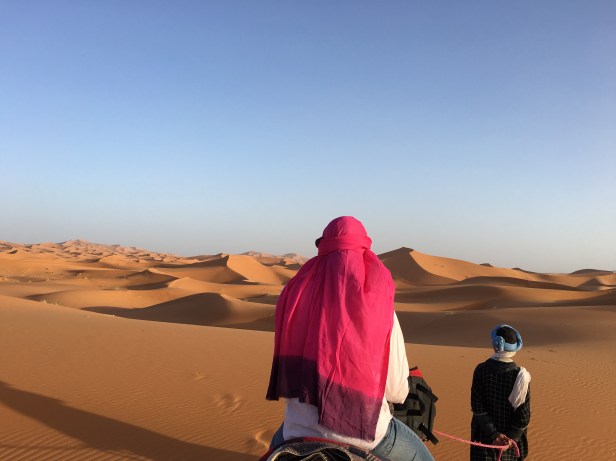
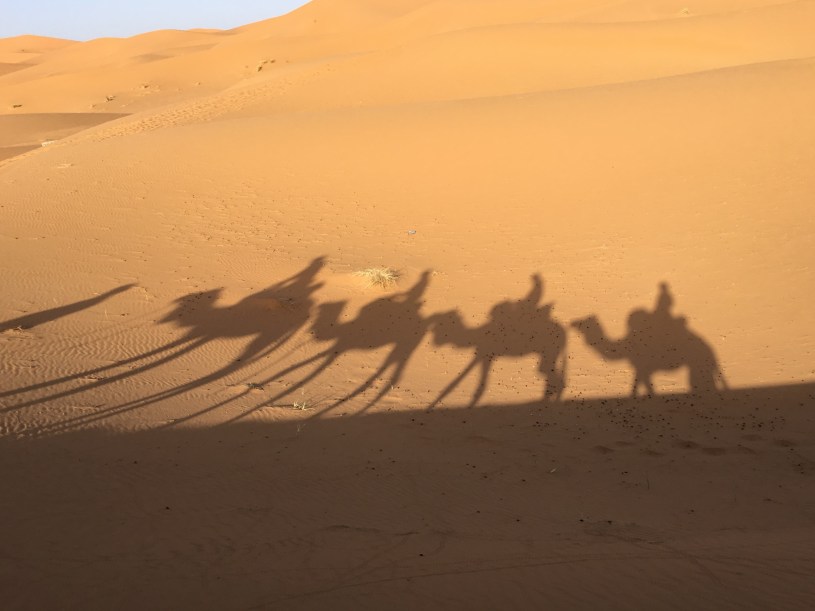
The shadows of us on camel back in single file were like Christmas card depictions of the Magi, the orange and golden colors spectacular. After 90 minutes, we reached our desert camp – another unexpected delight. Small metal yurts covered in black-out fabric were private bedrooms, complete with a pretty lantern, carpets and comfortable beds piled with blankets. There was even a real shared restroom – with ceramic hardware, real flushing and a tiled hand sink! We parked our camels, deposited our bags. then clambered up the tallest nearby dune for sundown – boots sinking into the sand, each step showering our toes with grains.

Dinner of salty vegetable and chicken tagine with salty rice and salty eggplant salad, capped off with sweet oranges, was served in a dining yurt, followed by drumming out mis-remembered Bob Marley tunes around an open air camp fire. A clear night, I spotted shooting stars. Authenticity at one point sacrificed, a guide whipped out a smart phone with an astronomy app to help us spot the Big Dipper and Venus before bed time.
Day 5: Drive through Drâa Valley back to Marrakech
At 7am, we headed back to the village on camel back to watch sunrise as we rode, this time the sand more yellow than orange. Hot showers greeted us at Hotel Kasbah Moyahut, followed by breakfast of fresh coffee, muffins and egg-tomato scramble to fuel a long 10 hour drive back to Marrakech.

Much of this return journey was through the Drâa Valley, the longest in Morocco. Clear rock strata jut up from the earth and deep crevices hewn by now-dried rivers into the red layered rock were reminiscent of the Grand Canyon. Eventually, we rejoined our original route through the High Atlas Mountains, finally arriving in Marrakech at 815pm. Do not assume you can get a flight out of Morocco on the evening of this third day of the tour – the mountain roads do sometimes close owing to rock fall. Instead plan supper in Marrakech and an onward journey the next day.
- Wish I had: Finished day 3 by driving to Fez from the Sahara – about 2 fewer hours on the road and time to see a new city.
 The Whistletrip